·
Product Review
·
8 min read
ProstAfense Review: What the Ingredients Actually Show — and Who This Is Really For
The sales page makes promises. The research tells a different story — more honest, and in some ways more interesting. Here's what we found.
Affiliate disclosure: This article contains an affiliate link to ProstAfense. If you purchase through it, we may earn a commission at no extra cost to you. — Published: May 15, 2026
If you landed here after seeing an ad — a video, a celebrity endorsement, someone describing results that sounded almost too specific to be invented — you already know what the pitch feels like.
We looked at the same product. Then we read the actual research. Not to debunk it, and not to sell it. To figure out what it actually does, who it realistically helps, and what the label isn’t telling you.
What’s in the Formula
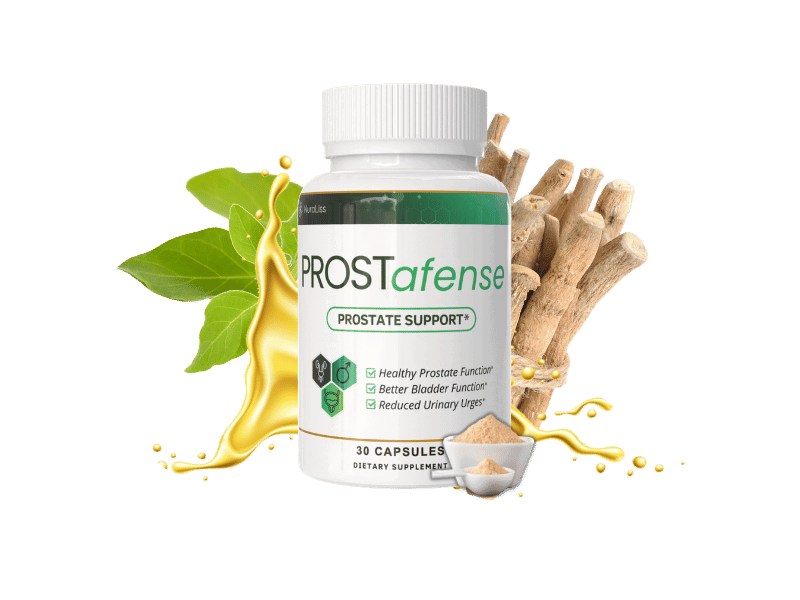
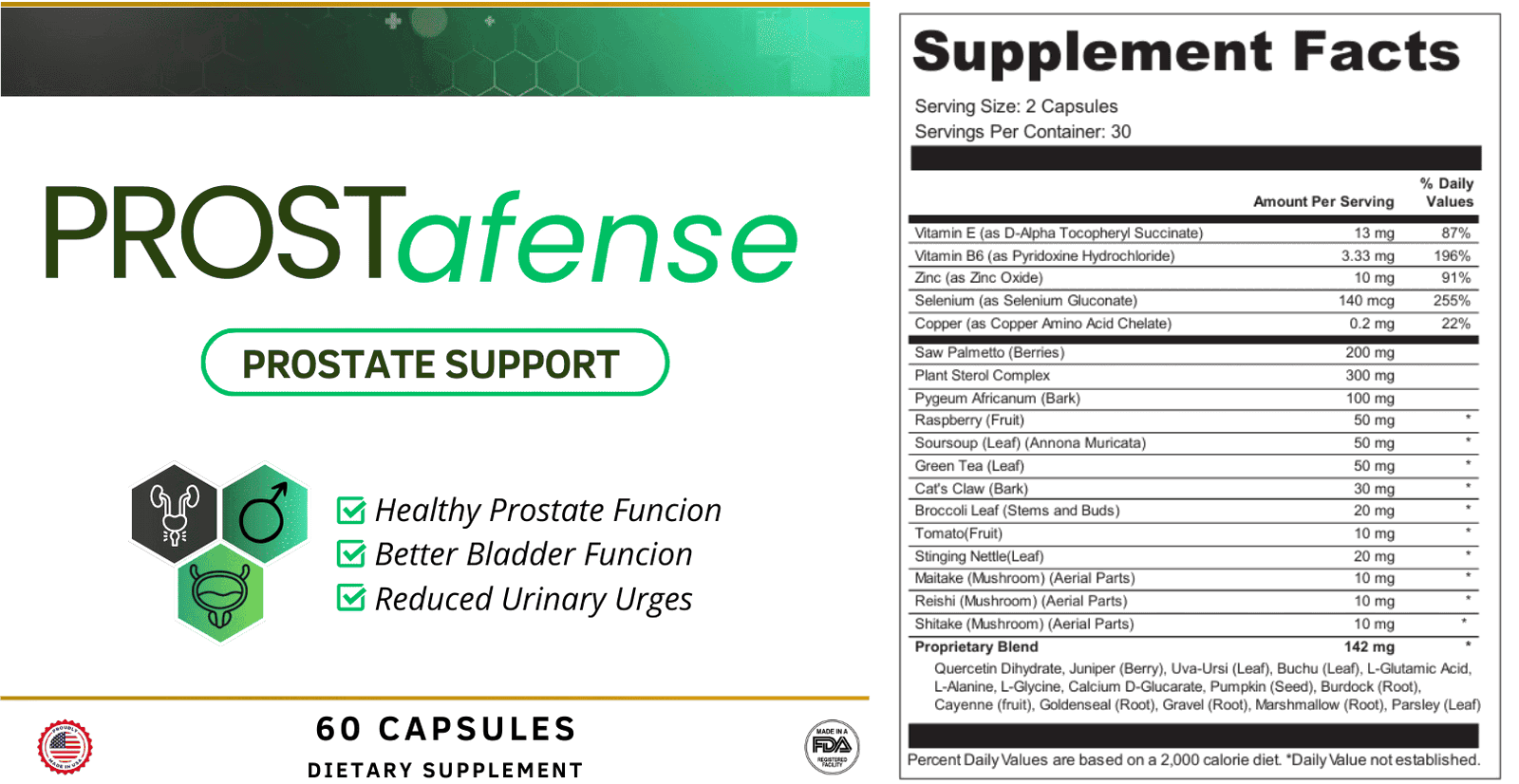
ProstAfense is a once-daily capsule. The full blend, as shown on the Supplement Facts label: Boron, Tongkat Ali, Ashwagandha, Fenugreek, Panax Ginseng, Maca Root, Artichoke Extract, Nettle Root — plus Vitamin B6, Selenium, and Vitamin E.
Individual dosages are not disclosed. We’ll address what that means for evaluating the formula after we go through each ingredient.
What the Research Actually Says
Nettle Root (Urtica dioica)
This is the ingredient with the strongest and most specific clinical backing for prostate-related symptoms in the formula. A randomized, double-blind trial published in PMC (NIH) involving 100 men with benign prostatic hyperplasia (BPH) found that nettle root extract produced significantly better symptom relief than placebo on the standard urinary symptom scale, with no adverse effects reported. A 2022 clinical trial found statistically significant improvements in urinary frequency, urgency, and nocturia — three of the most disruptive BPH symptoms — in men who added nettle root to conventional treatment.
The proposed mechanism: lignans in nettle root bind to sex hormone-binding globulin (SHBG), reducing its interaction with prostate membrane receptors. It’s a plausible, studied pathway that holds up across multiple trials.
The clinical backing here is moderate and specific. This is the ingredient that earns its place most clearly.
Boron
Less discussed than the botanicals, but one of the more interesting entries in this formula. A large epidemiological analysis published in PubMed using NHANES III data — covering over 8,700 men — found that higher dietary boron intake was associated with meaningfully lower prostate cancer risk in a dose-dependent pattern. A separate clinical review published in PMC found that boron supplementation increased free testosterone in men, likely by reducing SHBG.
What boron can’t claim: there are no large randomized trials confirming it prevents prostate cancer in humans. The association is real and interesting; the causality is not yet established.
The evidence is preliminary but scientifically grounded — and more interesting than the sales page gives it credit for.
Ashwagandha (Withania somnifera)
A 2021 systematic review published in PubMed identified ashwagandha as one of the most effective herbal extracts for increasing testosterone concentrations in men — the most comprehensive analysis of its kind. A crossover RCT published in PMC in aging, overweight males found measurable improvements in hormone levels and vitality markers. This is the same class of adaptogen we reviewed in our Lipotrine article — where Eleuthero and Ashwagandha both appear as ingredients with hormonal support evidence.
For prostate health specifically, ashwagandha’s relevance is indirect: supporting hormonal balance and reducing cortisol may contribute to overall endocrine function in aging men.
Moderate evidence for testosterone support. Indirect for prostate — but relevant to the hormonal picture this formula is trying to address.
Fenugreek
Included in the same 2021 systematic review as ashwagandha, fenugreek seed extracts showed positive effects on testosterone concentrations in men across multiple trials. The mechanism likely involves inhibition of aromatase — the enzyme that converts testosterone to estrogen.
Moderate evidence for testosterone support. A legitimate addition to this formula.
Tongkat Ali, Panax Ginseng, Maca Root
Three ingredients with varying evidence for male vitality broadly — energy, libido, general hormonal support. Panax Ginseng has the most robust overall evidence base. Tongkat Ali has emerging but still preliminary clinical data. Maca Root has some evidence for libido but very limited prostate-specific research.
Preliminary to moderate. Reasonable additions to a men’s health formula — not the clinical backbone of it, but not filler either.
Vitamin B6, Selenium, Vitamin E

Selenium has been studied in relation to prostate cancer risk — results have been mixed. The SELECT trial found no benefit from supplementation in men without selenium deficiency. Vitamin E and B6 are essential nutrients with established roles in cell protection, hormone metabolism, and immune function.
Nutritionally sound. They support the formula without changing its core clinical profile.
Who This Is For
Any man who takes his long-term health seriously.
Prostate health and testosterone levels aren’t concerns that appear only when something goes wrong. Every man’s testosterone declines with age — that’s not a condition, it’s biology. And the prostate is a gland that every man has, that changes over time in every man. The question isn’t whether to pay attention to it. It’s when.
Men who are already noticing early changes — getting up once or twice at night, taking longer to start, a gradual decline in energy or drive — will find the most immediate relevance in this formula. The nettle root and boron speak directly to that group.
But the men who tend to benefit most from a formula like this are the ones who don’t wait for symptoms to act. The ashwagandha, fenugreek, and ginseng in this blend support testosterone naturally — not as a correction, but as maintenance. The kind of thing that’s easier to sustain than to rebuild.
If you care about staying sharp, staying strong, and staying ahead of what age does quietly — this formula was built with that in mind.
When This Isn’t the Right Call
If you’re experiencing sudden, significant, or painful urinary changes — see a doctor first, before any supplement. If you’ve been diagnosed with prostate cancer or are in active treatment, this product is not appropriate. And if you’re expecting fast results: the sales page says “fast-acting.” The biology disagrees. Four to eight weeks of consistent use is the realistic minimum.
What We Actually Think
ProstAfense has a more considered formula than most products in this category. That’s not a low bar — it’s a real distinction.
Nettle root and boron are the two ingredients with the clearest, most specific clinical backing for prostate-related concerns. Both are present. Ashwagandha and fenugreek bring genuine evidence for testosterone support in aging men — not prostate-specific, but relevant to the hormonal picture. That’s a meaningful foundation.
What we’d improve: dosage transparency. The formula uses a proprietary blend, which means you can’t verify whether any individual ingredient reaches the threshold studied in clinical trials. That matters. It’s a real limitation, and we’ll come back to it.
The sales page oversells this product. Language like “Most Potent, Fast-Acting” and “youthful vitality” is not what the research supports — and if you’ve read our piece on what medical training often leaves out, you’ll recognize the pattern: a legitimate ingredient profile buried under a marketing layer that doesn’t need to be there.
The formula doesn’t need the exaggeration. The evidence, stated honestly, is enough for the right person.
That’s what this review is.
Family & Community Medicine · Medical Reviewer
This article contains an affiliate link. If you purchase through it, we may earn a commission at no extra cost to you. Our editorial assessment is written independently.
If This Sounds Like Where You Are
ProstAfense has the ingredient profile worth considering — nettle root, boron, ashwagandha, fenugreek, in a once-daily capsule. It’s not a cure. It’s not magic. It’s a formula with a reasonable evidence base for the right person, sold through a secure checkout platform that includes a 60-day satisfaction guarantee. If you’re in the group this was built for, the link below goes to the official site.
Affiliate link — commission may apply. Your price doesn’t change.
Where to Buy ProstAfense — and Why It Matters
ProstAfense has been getting a meaningful amount of attention lately — and with that attention comes something predictable in the supplement market: unofficial listings and look-alike sites.
A quick search will turn up multiple websites using the ProstAfense name — some are other affiliate review sites like this one, but others appear to be independent storefronts or marketplace listings on Amazon and eBay selling what they describe as the same product. Some sites have gone further, claiming the original formula was discontinued or replaced by a new version — a pattern that tends to appear when demand for a product outpaces the information available about it.
We can't verify the quality, storage conditions, or authenticity of product sold through those channels. What we can tell you is that buying outside the official website means buying from an unauthorized reseller — no traceability back to the manufacturer, no way to confirm the product is what it says it is, and no direct support channel if something goes wrong. A supplement purchased from a random Amazon seller has no path back to the brand. The official site does.
The official checkout is powered by BuyGoods — a legitimate, established payment and fulfillment platform used by many supplement brands in this space. When you click the buy button on the official site, you'll see a checkout page that looks like this:
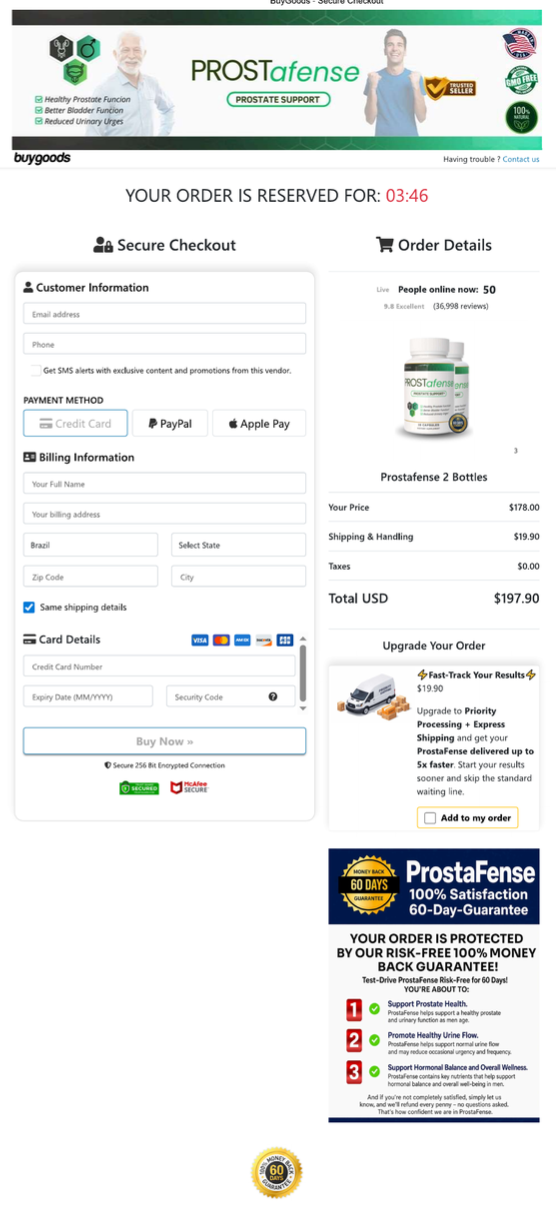
The BuyGoods checkout page — what you see after clicking the official Buy Now button.
The BuyGoods checkout handles your payment securely and routes your order directly to the manufacturer's fulfillment team. That's the chain of custody that protects your purchase and your support eligibility. If you're going to try ProstAfense, use the link below — it goes directly to the official site and the same checkout you see above.
Affiliate link — commission may apply at no additional cost to you.
Frequently Asked Questions
Does it actually work for BPH symptoms?
The ingredient with the most direct evidence for BPH symptom relief is nettle root, which has multiple randomized controlled trials showing improvements in urinary frequency, urgency, and nocturia. No supplement replaces clinical evaluation for BPH — but for men with mild early symptoms who want a botanical option, the formula has a reasonable evidence base.
How long before I notice anything?
Four to eight weeks of consistent daily use is the realistic minimum. Adaptogens and botanical extracts don’t produce immediate effects — that’s not a flaw in the formula, it’s how this class of compounds works biologically. The product page language about “fast-acting” results is not aligned with the research. Patience and consistency matter more than the first week.
Some ingredients — particularly Tongkat Ali and ashwagandha — may interact with hormone-sensitive medications or blood pressure drugs. Always discuss any new supplement with your prescribing physician before combining it with existing treatment. This is not optional advice.
Why doesn’t the label show individual dosages?
ProstAfense uses a proprietary blend format, which is common in the supplement industry but means the exact amount of each ingredient is not disclosed. This makes it difficult to compare against clinical trial dosages — and it’s a legitimate limitation worth factoring into your decision.
Is ProstAfense FDA approved?
No dietary supplement is FDA approved in the way prescription medications are. ProstAfense is manufactured in a GMP-certified facility, which speaks to quality control standards — but it does not mean the product’s health claims have been evaluated or approved by the FDA.
Should I use this instead of seeing a urologist?
No. If you’re experiencing prostate symptoms — urinary changes, discomfort, or any sudden shifts in function — a clinical evaluation comes first, always. ProstAfense can be a complement to medical monitoring, not a substitute for it. This is exactly the gap we write about in our piece on what medical training often misses — supplements fill a support role, not a treatment role.
The content above is for informational and educational purposes only and does not constitute medical advice. Statements about dietary supplements have not been evaluated by the Food and Drug Administration. This product is not intended to diagnose, treat, cure, or prevent any disease. Always consult with a licensed healthcare provider before adding any supplement to your routine.
Receba o Guia Gratuito
Os 7 Ingredientes Naturais Mais Estudados — o que a ciência realmente diz. Uma curadoria do Dr. Daniel Mercer, MD.
Sem spam. Só conteúdo que vale o seu tempo.
Get Wellness Wire
Independent wellness education, lifestyle guides, and transparent product information.
Content